Tuesday, 6 January 2015

Clocky:"A clock , not for a noble purpose!!"

Clocky:"A clock , not for a noble purpose!!"


Clocky is not your average alarm clock. It will sound an alarm to wake you up but if you don't get out of bed - it gets nasty.

It will jump off your nightstand. It will run around your floor. It will hide. And it will make lots of noise until you get out of bed - chase it - catch it - and turn it off.

Clocky has large rubber wheels and is encased in shock absorbing materials. It can bump, turn, and alter it's routes.

It was invented by Gauri Nanda, a graduate student at the Massachusetts Institute of Technology. She came up with the idea when she discovered that 40% of alarm clock users ignore the alarm and abuse the snooze button.

This crazy invention won a 2005 Ig Nobel Prize, a parody of the Nobel Prizes, which is given for unusual or trivial achievements in scientific research. "Ig" is a play on the word ignoble meaning "not a noble purpose".

Voice Stick:"Convert printed text into voice."

VoiceStick:"Convert printed text into voice."


Invented by Sungwoo Park, this cool new gadget is a portable scanning device that reads printed text and converts it into a voice.

The Voice Stick can read any written document such newspapers, books and mail.

It was the Gold Medal winner at the International Design Excellence Awards for new inventions.


Airnergy:"A WiFi hotspot power harvester.

Airnergy:"A WiFi hotspot power harvester."


RCA has developed a prototype of a cool new gadget capable of producing wireless electricity from radio frequencies in the air.

According to a company spokesman at the Consumer Electronics Show in Las Vegas, the device recharged a Blackberry from a 30% battery charge to full charge within 90 minutes.

The handheld wireless device (Airnergy) uses an antenna to absorb energy from frequencies and convert them into DC power inside its casing.The gadget is then connected via a USB port to charge your cell phone or mobile internet device.

Airnergy charges itself 24/7.

This product is expected to be available in a few years.

E-Pills:"Get to know about your internal body."


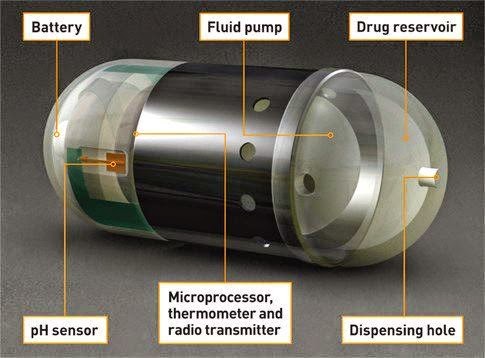
After years of investment and development, wireless devices contained in swallowable capsules are now reaching the market.Companies such as SmartPill based in Buffalo, New York and Israel-based Given Imaging (PillCam) market capsules the size of vitamin tablets.

These pills contain sensors or tiny cameras that collect information as they travel through the gastrointestinal tract before being excreted from the body a day or two later.These new electronic inventions transmit information such as acidity, pressure and temperature levels or images of the oesophagus and intestine to your doctor's computer for analysis.
Image source


Doctors often use invasive methods such as catheters, endoscopic instruments or radioisotopes for collecting information about the digestive tract. So device companies have been developing easier, less intrusive ways, to gather information.

Digestive diseases and disorders can include symptoms such as acid reflux, bloating, heartburn, abdominal pain, constipation, difficulty swallowing or loss of appetite.Doctors can inspect the colon and peer into the stomach using endoscopic instruments. But some areas cannot be easily viewed, and finding out how muscles are working can be difficult.Electronic pills are being used to measure muscle contraction, ease of passage and other factors to reveal information unavailable in the past.

Wednesday, 24 December 2014


Huawei has announced the Ascend GX1 (SC-CL00), the company’s latest mid-range smartphone in the Ascend series in China. It has a 6-inch HD screen with screen-to-body ratio of 80.5%, is powered by a 1.2GHz quad-core Snapdragon 410 processor and runs on Android 4.4-based Emotion UI. It has a 8-megapixel rear camera with LED flash and a 2-megapixel front-facing camera. It has several camera modes such as voice capture, quick capture from the lockscreen and more.
It has 1GB RAM, 8GB of internal storage with expansion slot and packs a 3500mAh battery. It has 4G FDD-LTE connectivity and comes with dual SIM support. It features leather-like back cover.

Huawei Ascend GX1 specifications
  • 6-inch (1280 x 720 pixels) HD capacitive touch screen in-cell touch-sensitive screen
  • 1.2 GHz quad-core Snapdragon 410 (MSM8916) processor with Adreno 306 GPU
  • 1GB RAM, 8GB internal memory, expandable memory up to 32GB via microSD
  • Android 4.4 KitKat with Huawei Emotion UI 3.0
  • Dual SIM
  • 8MP rear camera with LED Flash
  • 2MP front-facing camera
  • 9.2mm thick and weighs 173 grams
  • 4G LTE /3G, WiFi 802.11 b/g/n, Bluetooth 4.0, GPS, NFC
  • 3500 mAh battery


The Huawei Ascend GX1 comes in white color and is priced at 1590 Chinese Yuan ( Rs. 16180 approx.).

Thursday, 20 November 2014

INTEL CORE I7

Intel Core i7
 
Add captionIntel Core i7 is a name that the company Intel uses for the computer processors it makes for desktop and laptop computers . Intel uses this name for the fastest processors that they think will be used to build computers for consumers instead of business people. Intel started to use this name in 2008. Before 2008, Intel used the name "Core 2" for this kind of processor.
There are different types of Core i7 processor. The name does not name a type. Instead, it is the name for all of the fast processors that Intel thinks should be sold to consumers. Intel uses two other "Core i-" names for its processors for consumers: "Core i5" and "Core i3." Intel uses the "Core i5" name for processors that are not quite so fast as the "Core i7" processors. The "Core i5" processors can do most things that most people want to do quickly except for playing some types of computer games. Intel uses the "Core i3" name for processors for computers that are even slower than "Core i5" processors. "Core i3" can do most simple things for most people.[1][2][3][4]
Intel uses a different name, Xeon, for processors that Intel makes for "server" computers for businesses. Some of the "Core i7" processors are almost the same as some of the "Xeon" processors, but each of the Xeon processors is a little bit different than the "Core i7" processor, because a "server" computer is not the same as a consumer computer. Intel also makes other "Xeon" processors that are not the same as any "Core i7" processor. Unlike the Core i7, Xeon processors support ECC (error corrected) memory, and multiple CPUs on the same motherboard.

Central processing unit

central processing unit (CPU) is an important part of almost every computer. The CPU sends signals to control the other parts of the computer, almost like how a brain controls a body.
The CPU is an electronic machine that works on a list of things to do, called 'instructions'. It reads the list of instructions and does (executes) each one in order. A list of instructions that a CPU can read is a computer program. A machine that can perform the job of a CPU is often called a Turing machine by mathematicians.
The speed that a CPU works at is measured in Hertz, Hz. Modern processors often run so fast that gigahertz, GHz, is used instead. One gigahertz is one billion hertz.
The CPU market for desktop (home) computers is controlled by two companies: Intel and Advanced Micro Devices (usually shortened to AMD). There are other CPU manufacturers like ARM, IBM, VIA, MCST, ELVEES, SRISA, NTC Module, Sun Microsystems and others, but their CPUs usually have more specific uses (for example in mobile phones, cars, game consoles, or in the military).

Motherboard

The motherboard or mainboard is the main circuit board in a complex electronic system, like a computer. It is the most 'central' part of a computer. All of the different parts of the computer are connected to the motherboard. This lets them work together. In most computers, the motherboard is a big green board, but many come in different colors like black, red and yellow.

"On-board"

Electrical parts must be on the motherboard. These parts include transistors and resistors. Major parts that are attached to the board are able to be removed in the future so that they can be upgraded. The CPU is an example of a part that is usually removable.
Ports on an expansion card
Parts that are not "on-board" can be bought as a card. In fact, many of the on-board parts on today's computers were at one time an expansion card that became very popular. These were put on the board to free up the card slots for other things. Computers today usually have a memory port, 2 or more USB ports, a parallel port (for use with old printers usually), audio & microphone jacks, a network port and ports for the keyboard and mouse. There are also some rare motherboards that have plugs only for very specific parts.
All of the slots and plugs both inside and outside the computer case are shaped a certain way to accept a certain type of part. Some will not even accept parts even one generation behind, such as the CPU and memory. Others, like the video plug have not changed in years. Some of the plugs, such as the video, keyboard and mouse plugs, are a special color. These colors make it easier to pair the plug to the port. The motherboard is also referred to as the PCB which stands for ‘printed circuit board’


Wednesday, 5 November 2014

LENOVO YOGA PRO3

Lenovo Yoga 3 Pro with Broadwell Intel Core M-5Y70 

Lenovo Yoga 3 Pro with Broadwell Intel Core M-5Y70 detailed
Category: WINDOWS
 15.09.2014 - by Chris Knight
email3 COMMENTS
Europe is buzzing with news that an updated Lenovo Yoga 3 Pro is on the way. That’s something that the company didn’t show off at the recent IFA event in Berlin, but The Yoga 3 Pro was outed by Indonesia’s FCC and since been mentioned on Lenovo’s own pages. Having shown off the Yoga Pro 2 at last year’s event, the slightly late Yoga 3 update will keep the awesome a 13.3-inch qHD display, packing in an extremely high resolution 1800*3000 pixels. However, while previous models used Intel Core i5 and i7 processors, and suffered a shorter battery life, the new model will be driven by an Intel Core M-5Y70.
Rated as the best performing Core M processor with a base clock of 1.1 GHz and turbo up to 2.6 GHz, we wait to see whether this is makes for totally smooth performance and a longer operating time. The new Core M cope has a maximum TDP of only 4.5 watts, reducing the heat produced dramatically. It will be interesting to see how well the new Yoga 3 Pro device works with the new processor. And we have a suspicion that there will be other options with more powerful processors. This family of processors will soon be everywhere including the new Lenovo Helix 2, and could further shake up the market.
Keeping the main design of its predecessors, the Lenovo Yoga 3 Pro should come with a fully collapsible display for use in different positions for varying usage modes. With the new Intel Core M, it could be thinner and lighter, and perhaps cheaper, as the current model starts at €1,199. But that probably won’t be as important as the non-removable backlit keyboard for business users. Following the fanless trend, it should also be nice and quiet. We await an official announcement with interest as information starts to come out about the new Yoga 3 Pro model.